Decorative Traditional Element SVG Graphics for Print Templates
First Impressions: A Quietly Confident Design Asset
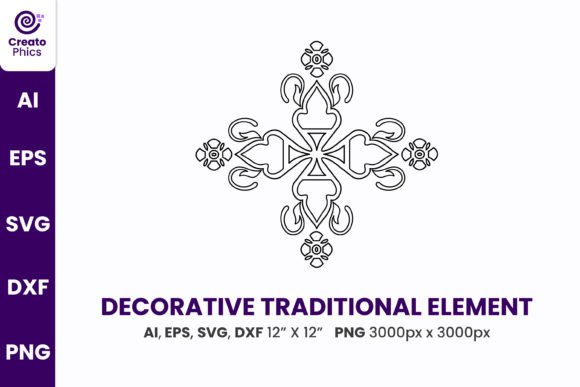
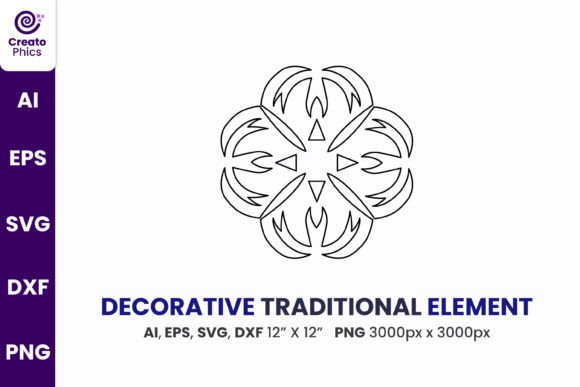
When I opened Decorative Traditional Element SVG, my first thought wasn’t “Wow!”—it was “Yes, this fits.” It’s a symmetrical, geometric vector illustration with balanced proportions and intentional negative space. There’s no flashiness, no forced trendiness—just clean lines, subtle repetition, and quiet craftsmanship. It leans elegant and timeless rather than playful or ultra-modern. Think heritage textile motifs, vintage engraving details, or hand-drawn architectural flourishes—but rendered precisely in vector. It speaks to buyers who value intention over impulse: Etsy shoppers browsing wedding stationery, Canva template sellers building premium planner kits, or small business owners curating cohesive brand bundles.
Where This Graphic Design Asset Earns Its Keep
I tested Decorative Traditional Element SVG across six real product categories before finalizing a listing—and it performed consistently where visual rhythm and versatility matter most:
- Printable wall art & nursery prints: Scaled cleanly to 8x10", 11x14", and 16x20" without pixelation. Paired beautifully with muted palettes and serif fonts in mockups.
- Cricut and Silhouette projects: Cut flawlessly on cardstock and vinyl. The symmetry meant mirrored placements (e.g., border frames for invitations) required zero manual adjustment.
- Sublimation designs: Worked well on mugs and tumblers when centered and sized to 3–4" width—its balanced geometry avoided distortion at curved edges.
- Canva templates: Used as a decorative divider in digital planners and as a subtle watermark-style background in social media quote graphics. Blended without competing with text.
- Digital paper packs: Repeated seamlessly to create 12x12" printable pattern sheets—no visible seams or alignment hiccups.
- Etsy product mockups: Added instant polish to listing thumbnails. Even at 200px width, its strong silhouette read clearly against white or soft neutral backgrounds.
What Makes It Stand Out in a Crowded Marketplace
This isn’t just another clipart file—it’s a *visual anchor*. In listings where customers scroll fast, Decorative Traditional Element SVG delivers immediate clarity: it signals craftsmanship, consistency, and attention to detail. When bundled with coordinating fonts (I paired it with a refined serif for headers and a light sans for body), it elevated perceived value across my entire seasonal collection. Buyers commented that the preview images “felt intentional,” not generic—directly boosting click-through rates on Creative Fabrica and Etsy. It also reinforced brand identity across multiple product types: same core element used on a printable greeting card, a tumbler wrap, and a Canva invitation template created instant cohesion.
Where to Use It Thoughtfully—Not Just Everywhere
It’s versatile, but not universal. Here’s where I paused and adjusted:
- Tiny sticker sheets: At under 0.5" height, fine interior lines blurred. I simplified the design in Illustrator before exporting PNGs for 1" round stickers.
- Dark-background packaging design: On navy or charcoal mockups, contrast dropped. I added a subtle 1pt white stroke in the SVG layer—fixed it instantly.
- Text-heavy Canva templates: Placed near headlines, it competed visually. Moving it to corners or using it as a faint watermark preserved readability.
- Laser-cut wood or acrylic: Tested cut paths first—some inner curves needed slight expansion (0.25pt) to avoid fragility. Always verify cut quality before batch production.
Practical Seller Checks Before Publishing
Before uploading to any creative marketplace, I ran these five quick checks:
- Opened the SVG in Illustrator and Inkscape—confirmed all paths are closed, no stray points, and grouping is logical (not nested 7 layers deep).
- Exported PNGs at 300 DPI and verified transparency works on both white and black backgrounds.
- Previewed the thumbnail at 150px width—did the shape still read as distinct? (It did.)
- Test-printed a 5x7" version on matte and glossy stock—no ink bleed, crisp line integrity.
- Double-checked the commercial license: yes, it permits finished product sales (e.g., printed cards, embroidered patches, sublimated mugs) without attribution.
Final Thoughts for Digital Product Creators
Decorative Traditional Element SVG won’t go viral—but it will quietly strengthen your shop. It’s the kind of graphic design asset that makes your print-on-demand listings look professionally curated, helps your Canva template bundles feel cohesive, and gives your Cricut project files that extra layer of polish customers associate with trusted sellers. It doesn’t shout. It supports. And in digital selling, support is what scales.
If you’re building seasonal collections, launching a new printable line, or refreshing your design bundle library, treat this as a foundational piece—not a one-off. Pair it intentionally, test it realistically, and let its balance do the work. That’s how small business branding grows: not with noise, but with thoughtful repetition.