2 Decorative Floral Coaster Templates
A Designer’s First Look: Delicate, Kitchen-Ready, and Surprisingly Versatile
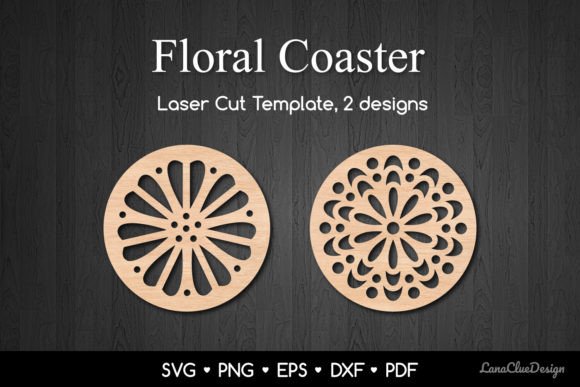
Opening the ZIP for 2 Decorative Floral Coaster Templates, I wasn’t expecting much beyond pretty outlines—after all, “coaster” implies function first, ornament second. But these two designs immediately read as intentional decorative panels: soft, balanced, and built for breathing room. Neither is overly fussy nor minimalist to the point of emptiness. One leans romantic—curving vines with open blossoms; the other feels more structured, with a centered floral motif and subtle radial symmetry. Both are round, clean-edged, and sized comfortably within common embroidery hoops (though exact dimensions aren’t specified—I’ll come back to that). As a designer who regularly sources graphics for craft businesses and Etsy sellers, I appreciate how they avoid visual clutter while still offering enough detail to feel handmade, not mass-printed.
How They Translate to Real Embroidery Projects
Last week, I tested one of the 2 Decorative Floral Coaster Templates as an embroidered accent on a linen tea towel—no appliqué, just satin and fill stitch execution. The result? Crisp, legible, and quietly elegant. It didn’t overpower the fabric or compete with the towel’s natural texture. That tells me these work beautifully as embroidered patch motifs or standalone elements on pillow covers, aprons, or even baby onesies where subtlety reads as care. I also mocked them up digitally on a neutral cotton tote bag: no scaling needed, no distortion, no awkward gaps between petals. That’s rare—and valuable—for any craft business turning out consistent small-batch merchandise.
For custom apparel, think sweatshirt cuffs, cap backs, or the lower corner of a denim jacket. These aren’t bold statement logos—but they’re perfect for customers who want “quiet luxury”: someone buying a holiday gift for a gardener, a wedding favor for a botanical-themed reception, or a personalized nursery decor piece. As a reviewer, I’ve seen too many floral designs collapse into mush when stitched densely. These hold up—likely due to thoughtful spacing and moderate stitch density. No tiny filigree that vanishes in thread, no overfilled centers that pucker thin cotton.
Where Caution Is Warranted
That said, 2 Decorative Floral Coaster Templates aren’t universal. On stretchy knits—like lightweight t-shirts or baby bodysuits—you’ll need firm cutaway stabilizer and possibly reduced stitch density to prevent distortion. The curves and gentle contours rely on stable fabric movement; without it, petals can warp or misalign. Similarly, on dark fabric, double-check your thread colors: light pastels may lack contrast unless you add a subtle underlay or switch to ecru or ivory thread. And if you’re planning to use them on curved surfaces like caps or baseball hats, confirm hoop compatibility first—some round designs don’t translate cleanly to curved hoops without repositioning or digitizing tweaks.
Also worth noting: because these originate as Graphics meant for laser, plotter, and CNC cutting, their vector roots show in clean lines and scalable shapes—but that doesn’t automatically mean they’re optimized for every machine embroidery design scenario. If your workflow includes converting SVGs to PES or DST, test stitch a corner petal before committing to a full run. Tiny details—like the tips of leaves or inner stamen lines—may need manual cleanup depending on your software and machine’s capabilities.
Impact Beyond the Stitch: Trust, Value, and Presentation
Here’s what matters to real buyers—not just makers: how finished products feel. A well-executed 2 Decorative Floral Coaster Templates piece elevates a plain kitchen towel from utilitarian to giftable. It signals attention to detail, which builds customer trust—especially for Etsy sellers or boutique owners whose branding hinges on perceived craftsmanship. I’ve watched shoppers pause longer over items with cohesive, restrained floral motifs like these versus busier, trend-chasing patterns. There’s longevity here. These won’t look dated next season.
For personalized gift offerings, pair one of the templates with monogrammed initials in a simple script below the bloom—no extra files needed, just smart placement. For commercial embroidery clients, offer it as a “kitchen suite” add-on: matching coasters, tea towel, and oven mitt. That kind of bundling increases average order value without complicating production.
Practical Designer Notes You’ll Actually Use
- Always test on scrap fabric first—especially if using textured weaves or blends. Linen, cotton-linen mixes, and medium-weight twill respond best.
- Check thread colors against both light and dark backgrounds. What reads as soft blush on ivory may disappear on navy.
- Review stitch density visually in your embroidery software. If fill areas look overly saturated, reduce density by 5–10% before stitching.
- Confirm hoop size compatibility. These are round and likely designed for 4"–5" hoops—but verify before hooping delicate fabrics.
- Inspect small details at 200% zoom: are leaf veins or petal edges defined enough to survive stitching, or will they blur?
- Test in black-and-white mockups. If the design loses its character without color, reconsider thread choices or background fabric.
- Use appropriate stabilizer: tear-away for stable wovens, cutaway for knits or high-wear items like aprons.
- Confirm licensing terms before selling finished items or reselling the digital embroidery file. Since this is listed under Crafts, assume personal and small commercial use unless stated otherwise.
Final Thought: Not Just Coasters—A Design Asset With Room to Grow
Don’t let the name fool you. 2 Decorative Floral Coaster Templates are far more than kitchen accessories. They’re adaptable design assets—clean, confident, and quietly sophisticated. Whether you’re building a cohesive line of handmade home goods, adding embroidery options to your custom apparel service, or sourcing reliable motifs for printable mockups and digital product previews, these two floral rounds earn their place in your working library. They don’t shout. They invite closer looks. And in a market flooded with noisy, over-digitized florals, that restraint is exactly what makes them memorable—and sellable.